Who Carries the Compliance Burden When Payments Fail?
Key highlights
- The compliance burden on a cross-border payment sits mainly with the regulated institutions in the payment chain; the sending business owns the accuracy of its instructions.
- Under the revised Recommendation 16 of the Financial Action Task Force (FATF), the payment chain starts at the institution that receives the customer's instruction.
- Each intermediary and receiving bank decides for itself when to execute, reject or suspend a payment that lacks required information.
- A UK Financial Ombudsman decision found a sending bank not responsible for a hold placed by an intermediary it did not choose.
- EU Verification of Payee rules move more of the compliance burden onto payment providers.
A supplier payment leaves on Monday and has not arrived by Friday. The sending bank confirms it went out. The supplier's bank has nothing. A bank the payer has never dealt with is asking questions, and nobody can say who owns the fix.
Compliance burden is the set of legal obligations attached to a payment, such as screening, data and record-keeping duties, plus the work and delay they create for each party.
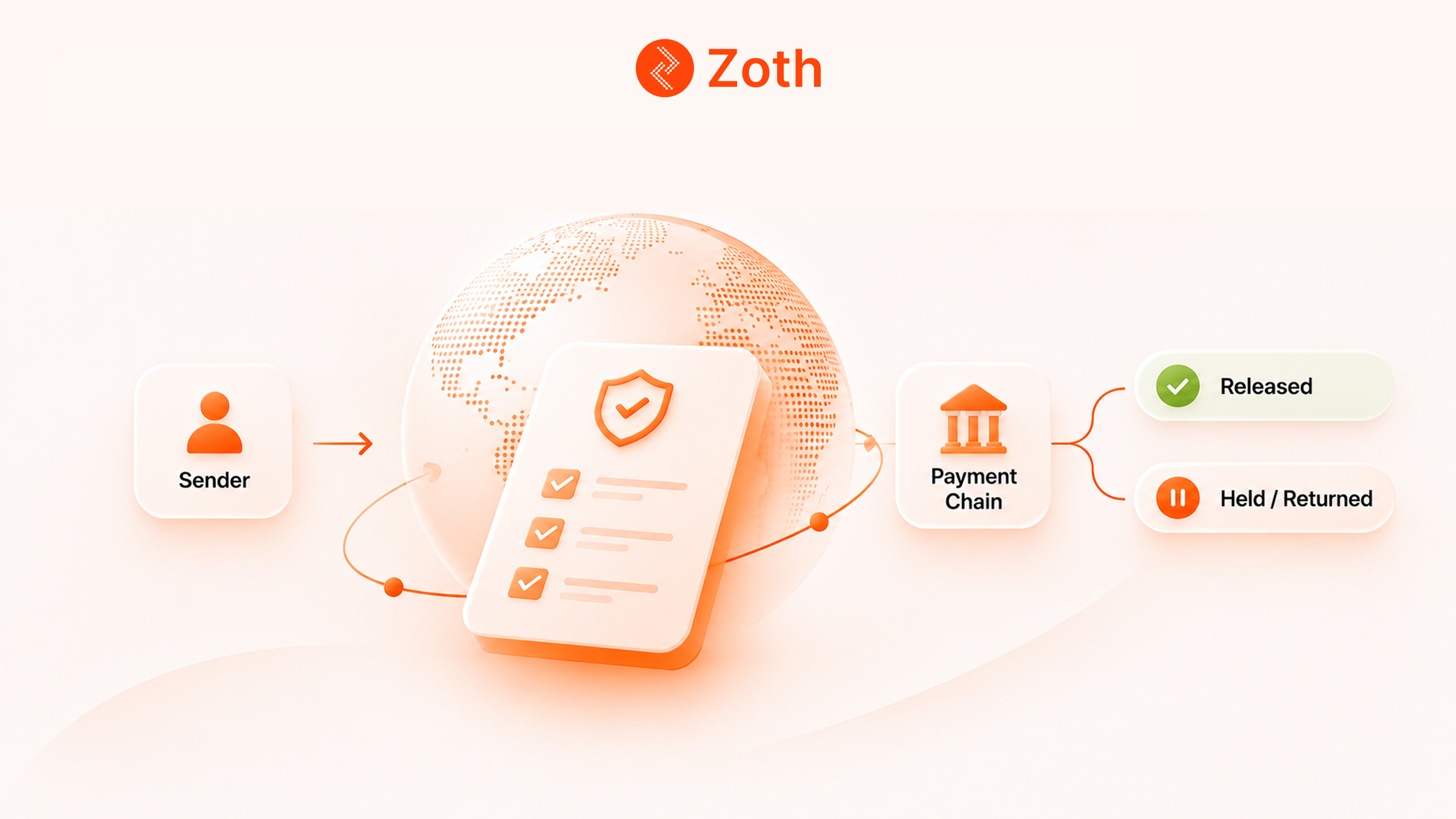
A held payment is paused by an institution in the chain for review. It can still be released.
A returned payment has been declined and sent back along the chain. Settling the invoice needs a new payment.
What does compliance burden mean in a cross-border payment?
The compliance burden has two halves that rarely land in the same place. Most of the obligation sits with regulated institutions. The consequence, a delayed supplier or an open invoice, lands on the business that sent the money.
The FATF Recommendations address payment rules to financial institutions, which is why the travel rule binds the provider rather than the payer. The sender still owns the accuracy of its instructions and its own legal duties, including those under sanctions law.
The working question in cross-border payment compliance is therefore not whether a payment is compliant. It is whose obligation stopped it, and whether the fix needs anything from the sender.
Where the compliance burden sits along the payment chain
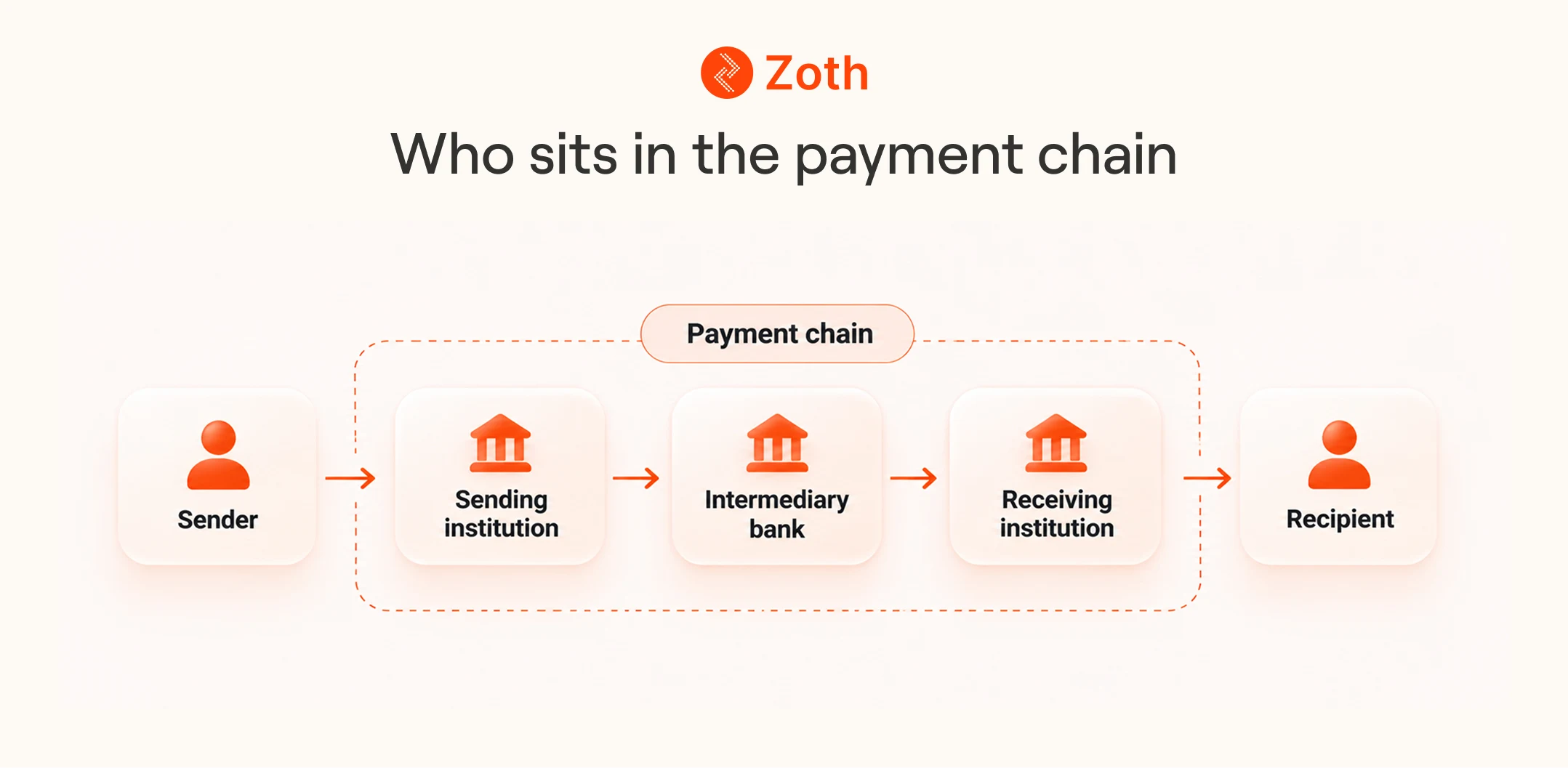
FATF revised Recommendation 16 in June 2025 to clarify responsibility in the payment chain, which now starts at the institution that receives the customer's instruction. Each institution after that carries its own compliance burden.
| Party | Compliance burden it carries | What it owns when a payment fails |
| Sending business | Accurate instructions; its own legal duties | Correct beneficiary data and documents |
| Sending institution | Complete sender and recipient data; record-keeping | Its own holds, recall requests and relayed queries |
| Intermediary bank | Keeping that data with the payment | Its own hold or rejection |
| Receiving institution | Verifying the recipient | Crediting, rejecting or returning the payment |
| Recipient | Keeping its account details current | A closed or blocked account |
Why the compliance burden splits at every bank
FATF's interpretive note gives intermediary and receiving institutions the same duty: risk-based policies on when to execute, reject or suspend a transfer that lacks required information. Each applies its own policy. A payment can clear the first bank and stop at the third, and the first bank cannot overrule that decision.
Held, rejected or returned: who owns the fix?
Where a payment stops decides who carries the compliance burden of fixing it.
| Where it stopped | Who decides | Who supplies the fix |
| Sending institution | The sending institution | Usually the sender |
| Intermediary bank | The intermediary | The sender, through its provider |
| Receiving institution | The receiving institution | The sender or the recipient |
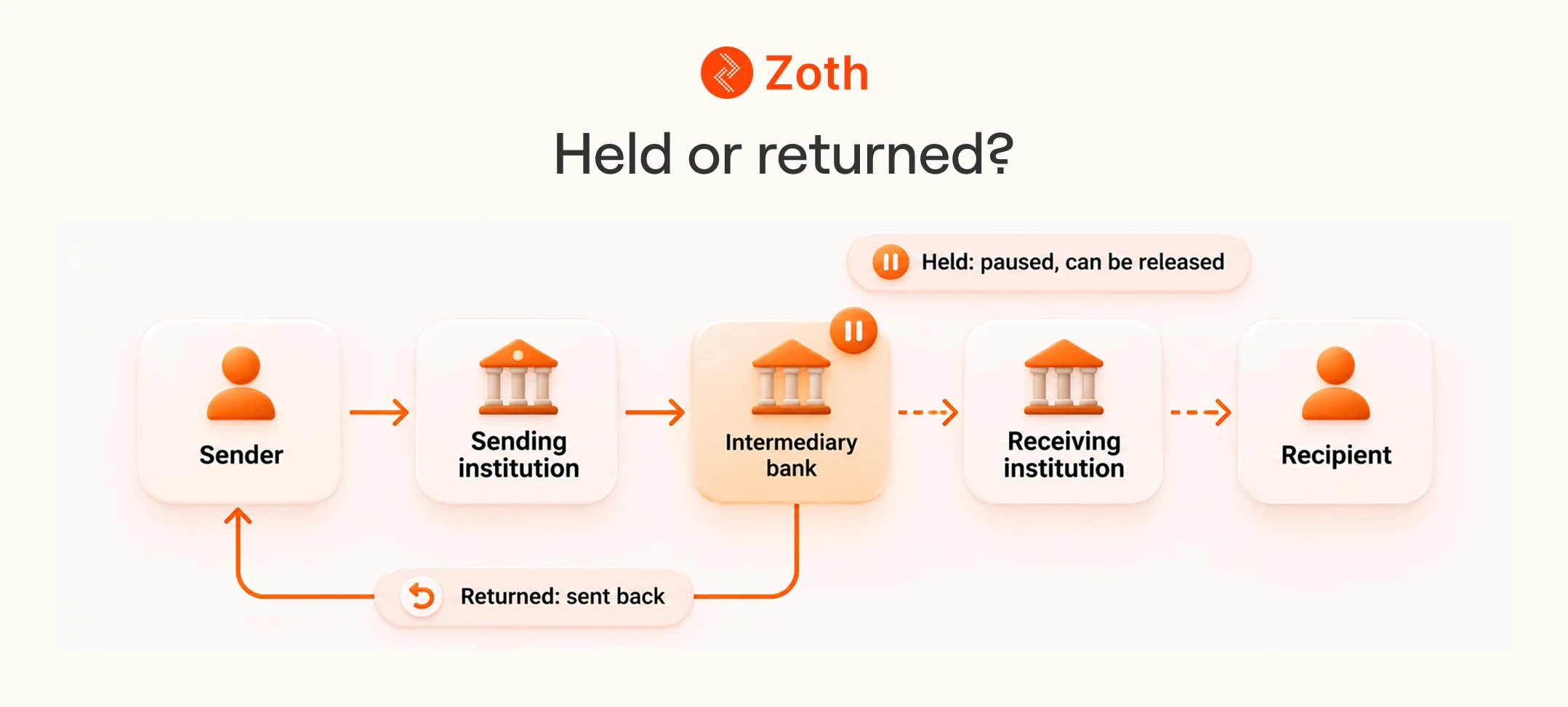
A payment returned over an ISO 20022 rail carries a standard reason code, and the code points to the owner:
- AC04, closed account: the recipient supplies new account details.
- BE01, name inconsistent with the account: the sender corrects the beneficiary data.
- RR01 to RR03, missing regulatory data: whoever holds the missing details supplies them.
- RR04, regulatory reason: the returning institution owns the decision, and the code carries no further detail.
Why the compliance burden reaches finance teams anyway
A 2023 UK Financial Ombudsman decision shows the gap. An intermediary bank held a payment, asked for more information, received it, and neither forwarded nor returned the funds.
The ombudsman found no basis in law or regulation for making the sending bank answer for the intermediary's decisions. The sending bank refunded a £5 fee and paid £50 for not keeping its customer informed. The payment stayed with the intermediary, and the sender carried the consequence.
How regulation is moving the compliance burden onto providers
Two rule changes are reshaping cross-border payment compliance. Article 5c of Regulation (EU) 2024/886 requires a payer's provider to verify the payee before a euro credit transfer is authorised. If the provider fails to run that check and the money reaches the wrong account, it refunds the payer. A payer who proceeds after a mismatch warning carries the loss. The rule applies in the euro area from 9 October 2025 and in other member states from 9 July 2027.
The revised FATF standard follows the same direction. By the end of 2030, countries are expected to require institutions to use tools such as recipient verification, and to keep payment data unchanged along the chain.
Four questions on cross-border payment compliance ownership
Asked before the first payout, these questions turn an unclear compliance burden into named owners.
- Which entity is the institution of record for each payout, and under which registration or licence?
- Which partner delivers the final leg in each corridor, and who regulates it?
- When a payment is held downstream, who chases it?
- When a payment is returned, is the reason code passed on?
They sit alongside the questions a payments team already asks on sanctions screening.
An ROI framework for cross-border payment compliance
A CFO values clear ownership of the compliance burden per corridor, on four lines.
| ROI line | How the CFO measures it | What Zoth Payments Limited changes |
| Returns avoided | Returns a year × cost to investigate and re-send each | Beneficiary data captured once, reused and screened on every payout |
| Capital released | Days funds sit in holds or returns × value × cost of capital | No correspondent chain on the payout leg |
| Hours saved | Monthly hours chasing holds × hourly cost | Screening, monitoring and, where in scope, travel rule checks run on the platform |
| Supplier terms kept | Late-payment charges and missed discounts a year | Payout status tracked, records exportable |
Annual return per corridor = returns avoided + capital released + hours saved + supplier terms kept
A Head of Payments gets one point of contact for a held or returned payout, instead of a chain of banks the team has no relationship with. Where the law allows, that contact explains the reason.
Where zPayments sits when a payout fails
Zoth Payments Limited runs zPayments. It is registered with FINTRAC as a money services business (registration number C10001622), which is a registration rather than a licence. Screening, monitoring and, where in scope, travel rule checks run on the platform rather than on the sender.
Value moves on stablecoin rails and lands in local currency through regulated payout partners in each supported corridor, with no correspondent chain on the payout leg. The sender's own obligations, including the accuracy of beneficiary data, remain the sender's.
Zoth Payments Limited is itself a regulated party in the payment chain. It can hold or decline a payment, for example after a sanctions match, a high-risk wallet alert or missing travel rule data. It does not explain a hold linked to a suspicious transaction report, because section 8 of Canada's Proceeds of Crime (Money Laundering) and Terrorist Financing Act restricts disclosure of such reports.
Running payouts across emerging markets? Review your payout chain with an International Payment Specialist at Zoth Payments Limited, today.
Frequently asked questions
Who carries the compliance burden when a cross-border payment goes wrong?
The sending, intermediary and receiving institutions each carry their own. The sending business sits outside the chain but owns the accuracy of its instructions and its own legal duties.
Is the sending bank responsible if an intermediary bank holds a payment?
Not for the intermediary's decision. A 2023 UK Financial Ombudsman decision found no legal basis for holding the sending bank responsible, though it was still expected to chase the payment and keep its customer informed.
What is the difference between a held and a returned payment?
A held payment is paused and can still be released. A returned payment has been declined, so the invoice needs a new payment.
What does return reason code RR04 mean?
It means the returning institution declined the payment on regulatory grounds. The code gives no further detail.
Does a payment provider take on a business's own compliance obligations?
No. A provider carries its own obligations as a regulated institution. A business's own duties, including accurate payment instructions, stay with the business, so cross-border payment compliance is shared between them.