Transparent FX Rates for Businesses in Emerging Markets
Key highlights
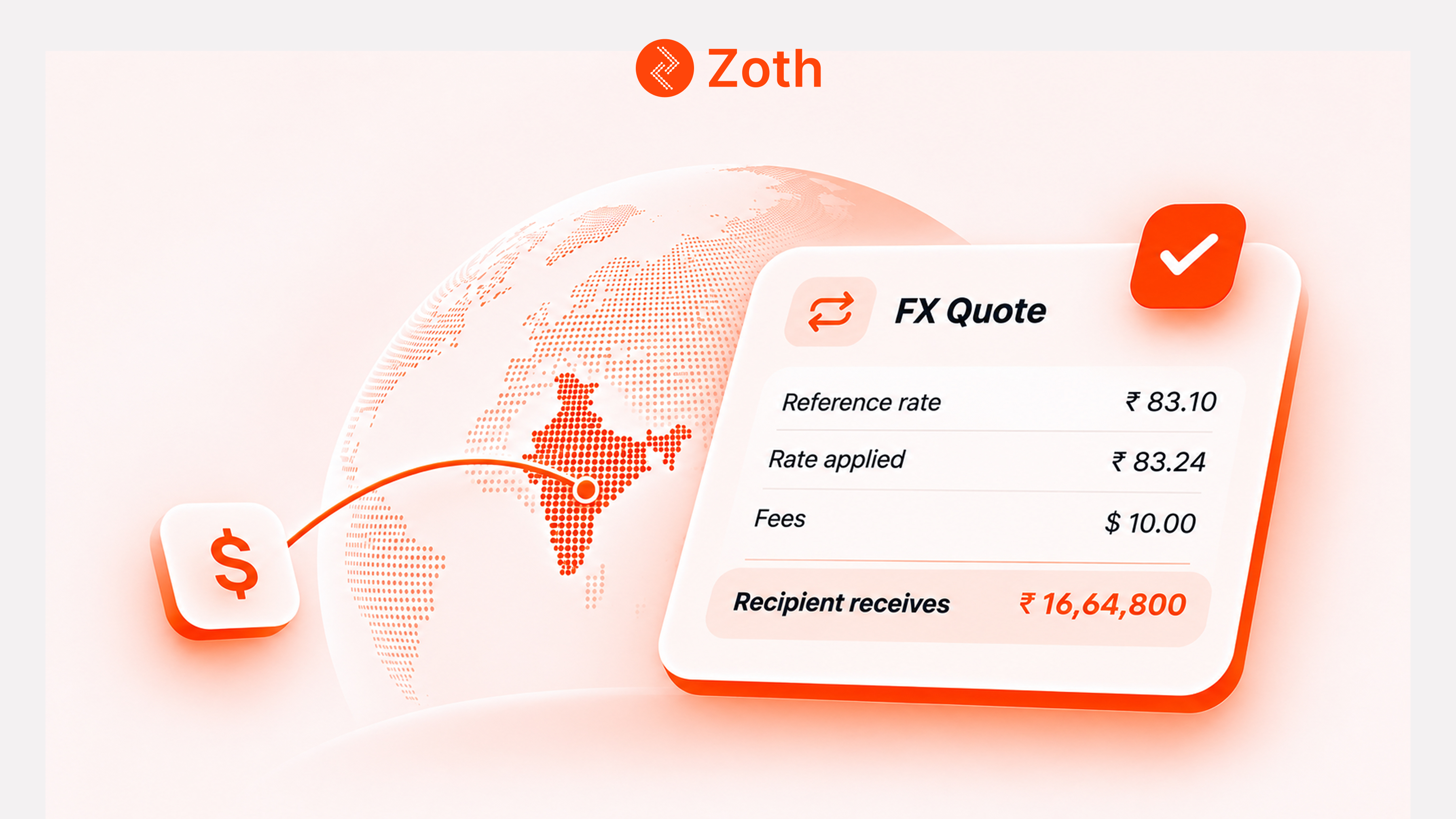
- Transparent FX rates for businesses state the rate applied, the reference rate behind it, every fee and the amount the recipient receives, before the payment is approved.
- Emerging market FX does not behave like EUR/USD. Onshore and offshore markets, capital controls, official benchmarks and thin local liquidity all shape the rate.
- Emerging market currencies reached 29% of global FX turnover in April 2025, yet capital controls that limit deliverability keep many of those markets fragmented.
- The return on transparent FX rates for businesses is measurable: landed-amount gain per corridor × annual corridor volume.
A finance team paying a vendor in euros can check its rate against one public number. A team paying a contractor in rupees faces a harder question first: which number. One currency can carry an onshore rate, an offshore rate, an official benchmark and a market rate, and a quote may be measured against any of them.
Transparent FX rates for businesses are quotes that state the exchange rate applied, the reference rate it is measured against, every fee charged and the exact amount the recipient will receive, before the payment is approved.
Emerging market FX is the market for currencies such as the Indian rupee, where capital controls, restricted convertibility or thin local liquidity make rates behave differently from major pairs.
The landed amount is the sum that reaches the recipient's account in local currency after every conversion and deduction.
How to measure a spread is covered in the FX spread guide. This post explains why transparent FX rates for businesses in emerging markets start with naming the reference point, because the reference point itself can move.
Why Transparent FX Rates for Businesses Differ in Emerging Markets
On major pairs, the mid-market rate, the midpoint between the buy and sell prices, is one public number. Both currencies move freely, liquidity is deep, and the difference between two quotes comes down to margin.
Emerging market FX runs on different terms. The BIS review of its 2025 Triennial Survey notes that capital controls limit deliverability and fragment these markets. Fragmentation means one currency can carry more than one price at the same moment. Four forces shape the rate.
Onshore and offshore rates
Where a currency cannot be freely delivered abroad, an offshore market forms around non-deliverable forwards, contracts settled in dollars rather than the local currency. A BIS working paper published in October 2026 found that a $1 billion rise in offshore dollar demand moves the onshore exchange rate by about 10 basis points within minutes. The gap between offshore and onshore rupee prices widened again when Indian banks' access to offshore markets was restricted in 2026. An RBI working paper found that volatility spills over from offshore to onshore rupee markets, more strongly when the rupee is under pressure. Two quotes for the same rupee payment can therefore differ before any margin is added.
Capital controls
In emerging market FX, controls decide who may buy or sell a currency, where and for what purpose. They limit how much liquidity reaches the market a provider trades in, and where volume is thin, spreads widen and prices move faster. In March 2026, the RBI capped banks' net open rupee position in the onshore market at $100 million at the end of each business day.
Reference rates and live rates
Rates also differ by timing. In India, the FBIL reference rate is set once a day, while the onshore spot rate moves through the day. The two need not match when a payment is priced, so transparent FX rates for businesses say which one they use.
Thin local liquidity
The final conversion into local currency runs through whoever holds that currency locally. Local liquidity sets the price, and depth on that last leg decides the landed amount, as the stablecoin vs SWIFT comparison sets out.
Four Tests for Transparent FX Rates for Businesses
Each test separates transparent FX rates for businesses from quotes that only look clear, and each can be answered before approval.
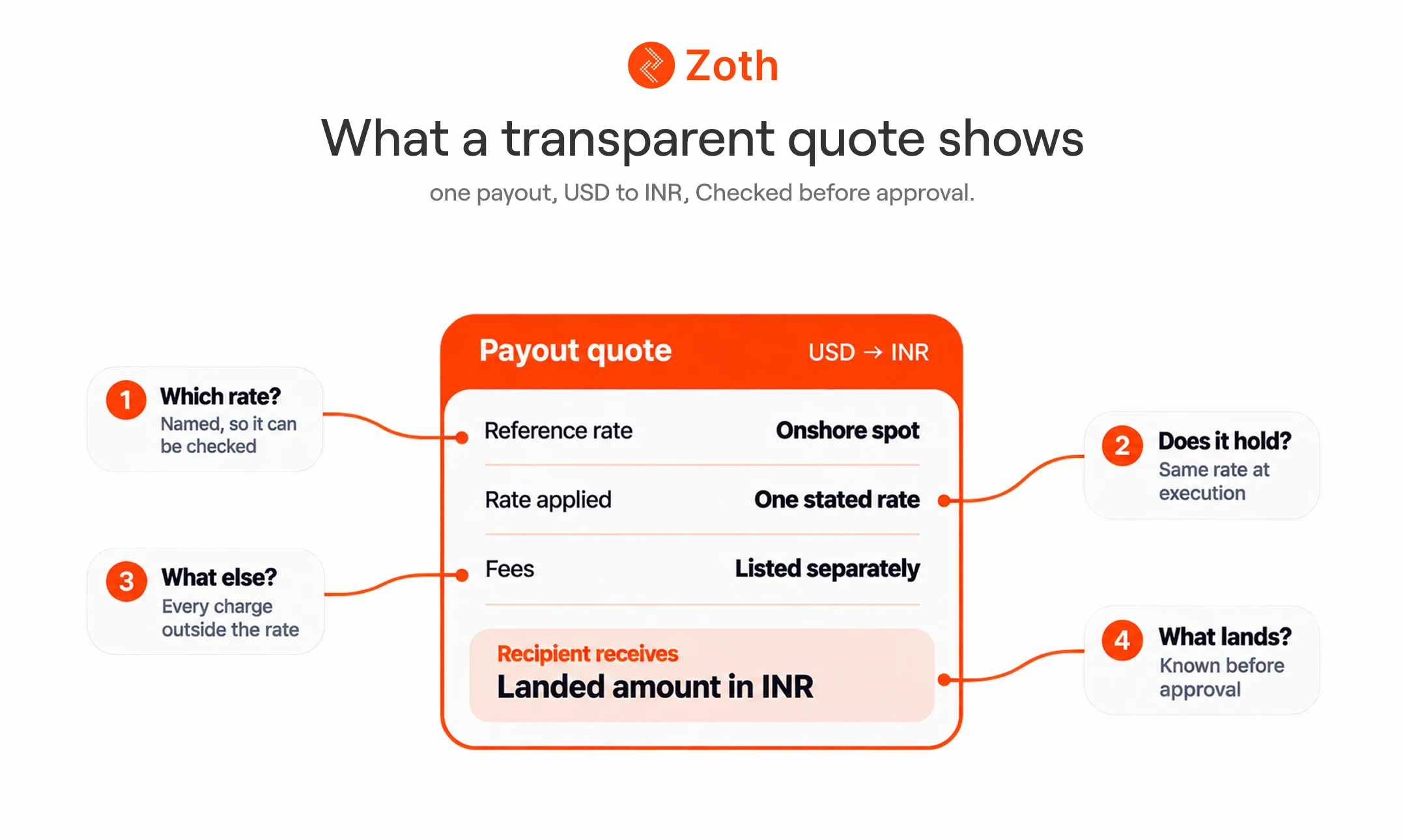
| Test | Question to ask | Why it matters in emerging market FX |
|---|---|---|
| Reference rate | Which rate is this quote measured against? | Onshore, offshore and official rates can differ. In India, FBIL publishes the USD/INR reference rate every Mumbai business day. |
| Landed amount | How much will the recipient receive in local currency? | The amount sent does not show the amount that lands. |
| Fees | Which charges sit outside the rate? | A narrow rate margin can sit beside a high fixed fee. |
| Rate hold | Does this rate apply at execution? | Thin markets move between quote and payment. |
An ROI Framework for Transparent FX Rates for Businesses
For a CFO, the value of transparent FX rates for businesses is measured in landed amount, not headline margin.
- Landed-amount gain per corridor = (landed amount on the new route − landed amount on the current route) ÷ amount sent
- Annual value per corridor = landed-amount gain per corridor × annual corridor volume
- Total annual value = the sum of every corridor
As an illustration, a business sending $200,000 a month into India, $2.4 million a year, whose landed amount improves by 0.4% keeps $9,600 a year on that corridor alone.
What a finance team gets:
- A per-corridor cost figure the CFO can budget with, instead of one blended number.
- A known landed amount before approval, which gives reconciliation a fixed figure to match.
- One basis on which a head of treasury can compare routes, corridor by corridor.
How zPayments Quotes Transparent FX Rates for Businesses
Zoth Payments Limited runs zPayments, a cross-border payout platform for businesses paying into emerging markets. zPayments pays at one stated rate in the destination currency, shown with the recipient amount before the payout is approved. Local liquidity sets the price, so the quote reflects the market where the money lands.
Zoth Payments Limited is registered with FINTRAC as a money services business (C10001622). Businesses fund each payout from their own wallet, and Zoth Payments Limited holds no client balance. Value moves on stablecoin rails and lands in local currency through regulated payout partners. Every payment is screened, and sender and recipient details travel with each transfer.
Running payouts across emerging markets? Audit your cross-border payout fees with an International Payment Specialist at Zoth Payments Limited today.
Regulatory Disclosures & Mandatory Risk Notices
Disclaimer: This article is provided for informational and educational purposes only and does not constitute financial, legal, tax or investment advice.
Service Availability & Compliance: Zoth Payments Limited is registered with FINTRAC as a money services business. Local-currency payouts are delivered through regulated payout partners, subject to applicable local laws. All transactions remain subject to identity verification (KYC/KYB), anti-money laundering (AML) monitoring, sanctions screening and the FATF Travel Rule. Submission of a payout does not guarantee its execution or timing, and exchange rates, payout amounts, fees and settlement times may vary.
Digital Asset Risk Notice: Stablecoins and digital assets carry inherent risks, including market volatility, potential de-pegging, smart contract vulnerabilities, liquidity limitations and changing regulatory frameworks. Digital assets are not legal tender in most jurisdictions and may not be backed by government deposit insurance (e.g., FDIC, CDIC).
Frequently asked questions
What are transparent FX rates for businesses?
Transparent FX rates for businesses are quotes that state the rate applied, the reference rate, every fee and the recipient amount before approval.
Why does emerging market FX behave differently from major pairs?
Onshore and offshore markets, capital controls, official benchmarks and thin local liquidity can give one currency several prices at once. Major pairs trade freely in deep markets with one public mid-market rate.
What is the difference between an onshore and an offshore rate?
An onshore rate is set in the currency's home market under local rules. An offshore rate forms abroad, often through non-deliverable forwards settled in dollars. The two diverge most when access between them is restricted.
Which reference rate should a business use for INR payouts?
The one its provider names in the quote. Onshore spot and the daily FBIL reference rate are common references. A quote that names no reference cannot be measured.
How can a CFO measure the value of transparent FX rates for businesses?
Multiply the landed-amount gain per corridor by annual corridor volume, then add the corridors together.
Does zPayments show the rate before a payout is sent?
Yes. zPayments shows one stated rate and the recipient amount before the payout is approved.