Cross-Border Payment Delays: Why Payouts Take Days
Key highlights
- Cross-border payment delays come from the calendar, not the distance: cut-offs, closed settlement systems, weekends and time zones.
- The receiving bank’s leg is the slowest part of a payment, according to the Financial Stability Board (FSB).
- Business payments wait longest. Only 5.9% of B2B payment services credited funds within one hour in 2024.
- Of 62 central bank settlement systems surveyed by the Committee on Payments and Market Infrastructures (CPMI), only five operated seven days a week.
- A three-line ROI framework turns days in transit into one annual figure.
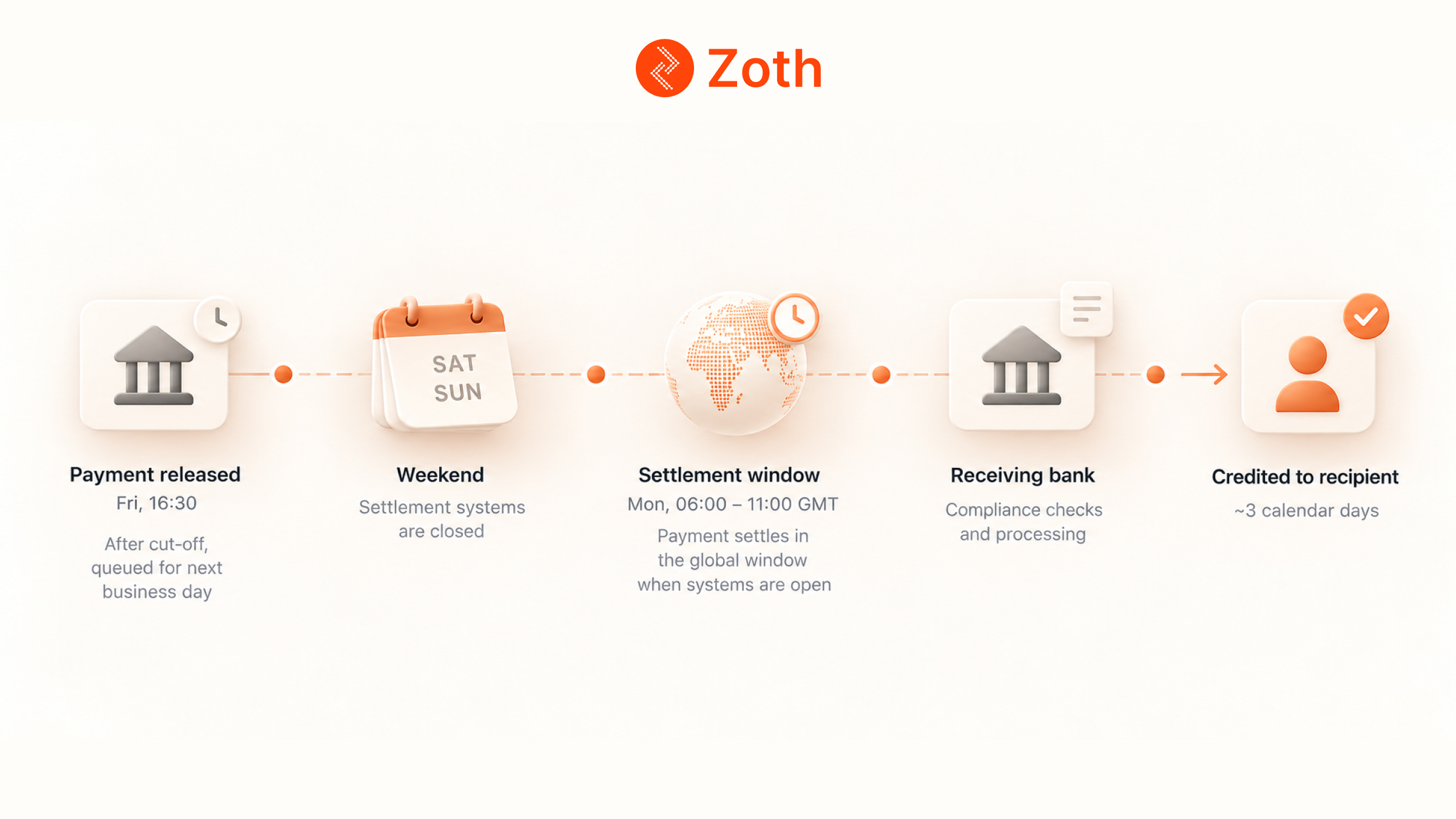
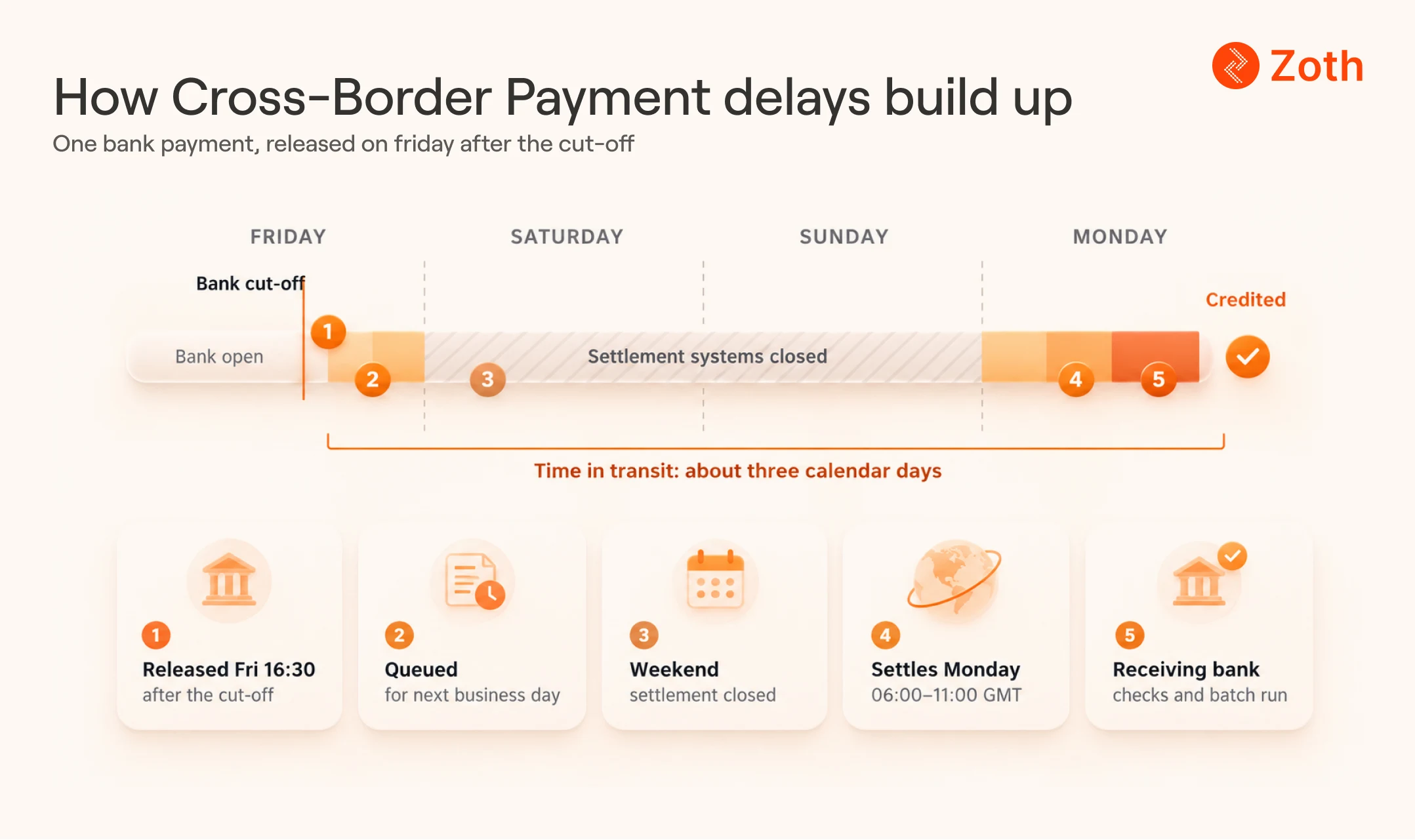
A payment instructed on a Friday afternoon can still be in transit on Tuesday. Nothing has failed. It met a cut-off, a weekend and a time zone, and each added a day. For a head of payments running payouts across several corridors, cross-border payment delays are built into the schedule of correspondent banking.
Three definitions frame the problem.
Cross-border payment delays are the gap between the moment a business instructs an international payment and the moment the recipient can use the funds.
International payment processing time is that gap measured end to end: the sending bank, the network in between and the receiving bank crediting the account.
The beneficiary leg is the final stage, from the receiving bank getting the payment to the funds reaching the recipient's account.
Where cross-border payment delays start
The FSB splits a correspondent banking payment into three legs: originator, in-flight and beneficiary. In its 2024 KPI report, 90.4% of wholesale payments completed the in-flight leg within one hour. Most cross-border payment delays sit at the two ends, where local hours and rules apply.
Cut-off times and closed settlement systems
Banks accept international instructions until a daily cut-off; anything later counts as received the next business day. Behind the bank sits the central bank’s settlement system, which the CPMI found was open almost 11 hours a day on average. Some systems set earlier cut-offs for international payments than for domestic ones.
Weekends, holidays and time zones
The same CPMI stocktake covered 62 settlement systems. Only eight had any weekend hours, five operated seven days a week, and six opened on public holidays. For some pairs of systems in different regions, the gap in operating hours exceeded 20 hours per working day, and Brazil’s system had no overlap at all with South Korea’s.
The CPMI places the global settlement window, when the most systems are open together, at 06:00 to 11:00 GMT on working days. The FSB adds that payments following the sun arrive faster than those sent against it.
Compliance reviews and capital controls at the receiving bank
Swift's explanation of beneficiary-leg delays, reported by the FSB, names four causes: capital controls, settlement systems that do not run 24/7, bank offline hours and batch processing, and anti-money laundering procedures. The FSB's 2025 progress report adds that capital control checks can hold a credit for hours or days, especially where documents are incomplete.
Batch processing on the last mile
Even a round-the-clock domestic rail can add cross-border payment delays through scheduled runs. India's NEFT operates 24/7 but settles in 48 half-hourly batches a day, per the Reserve Bank of India. A payment that arrives just after a batch closes waits for the next one.
International payment processing time in the data
The FSB measures international payment processing time against a G20 target of 75% of payments credited within one hour by end-2027, a target its 2025 report calls unlikely to be met. Business payments show why.
- B2B is the slowest use case. In 2024, only 5.9% of B2B payment services credited funds within one hour, against 46.4% for person-to-person payments.
- Emerging-market corridors lag. In 2025, 0.5% of B2B payment services from East Asia and the Pacific credited funds within one hour. No B2B payment service from South Asia credited funds within one hour, and only 28.3% of services did so within one day.
- Receiving regions differ sharply. Only 25.6% of wholesale payments into Asia-Pacific were credited within one hour in 2025, against 73.1% into North America.
The FSB's wholesale speed measures exclude weekends and bank holidays in the processing bank's location. Measured in calendar days, as a recipient experiences it, international payment processing time is longer than the published figures.
What cross-border payment delays cost: an ROI framework
The head of payments owns time to credit. The CFO owns the cash held in transit. One formula gives both of them a single figure for cross-border payment delays.
Annual cost of cross-border payment delays = float cost + exception cost + payee cost
| Cost line | How to measure it | What to ask a provider |
|---|---|---|
| Float cost | Annual payout value × average calendar days in transit ÷ 365 × cost of capital | What is time to credit, in calendar days, per corridor? |
| Exception cost | Payments needing investigation × hours per case × loaded hourly cost | What share of payouts complete first time? |
| Payee cost | Payouts credited after the promised date, tracked per corridor | Can a payout be released and credited outside banking hours? |
In an illustrative case, a business that pays out $1.5m a month, with three calendar days in transit and an 8% cost of capital, carries about $11,836 a year in float. Thirty investigations a month, at three hours each and $50 an hour, add $54,000 a year. Chasing late payments costs more than holding the cash in transit.
The third line rarely has a price, but it decides whether payees keep accepting the business's terms.
Five ways to reduce cross-border payment delays
- Instruct inside the overlap. Release payments before the sending bank's international cut-off, and avoid Friday releases into corridors whose systems close at weekends.
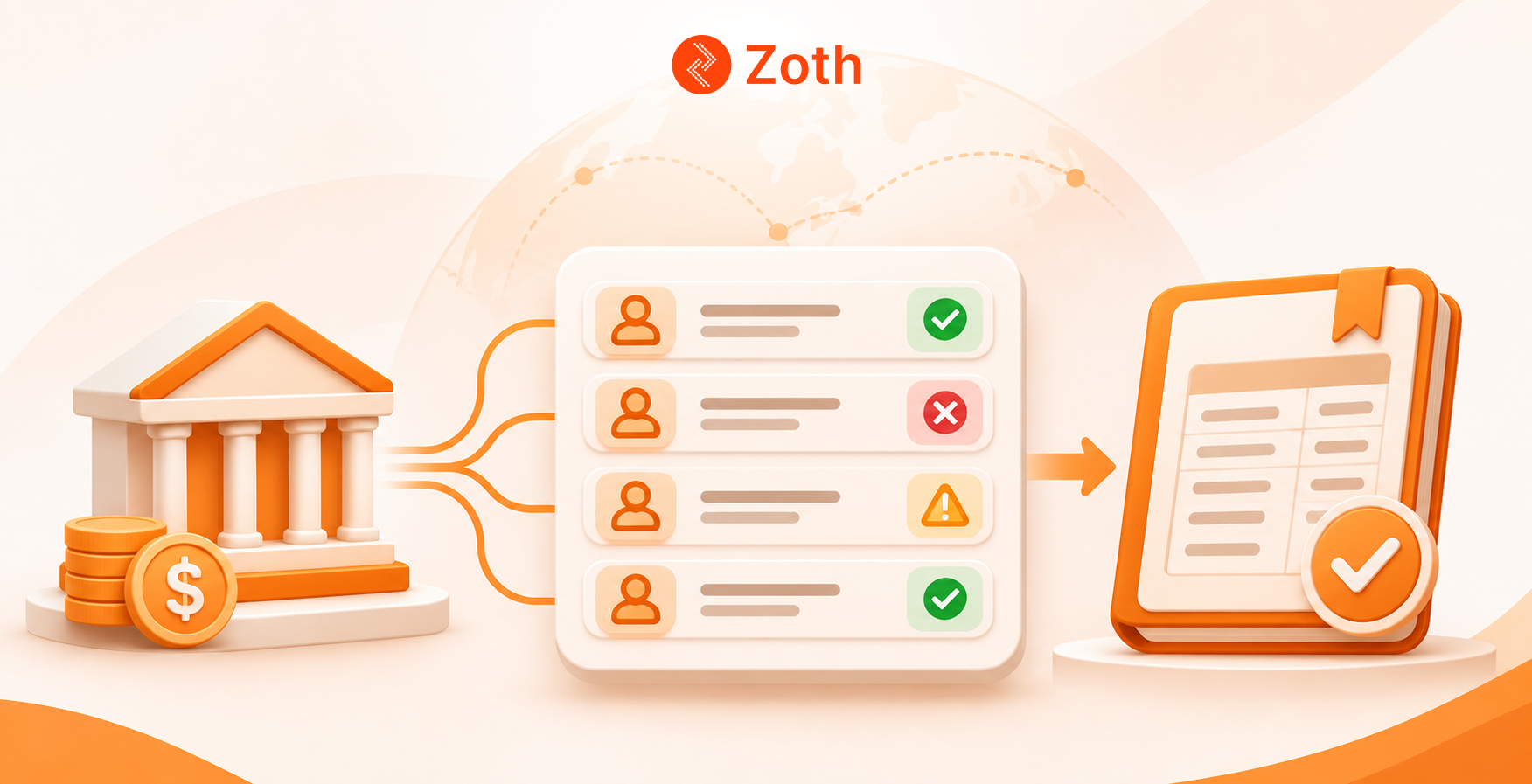
- Validate beneficiary details before release. The CPMI recommends pre-validation to cut rejections and manual repairs.
- Prepare documents for controlled corridors. Invoices and purpose details held ready shorten reviews at the receiving bank.
- Measure per corridor, in calendar days. A global average hides the corridors where cross-border payment delays concentrate.
- Move the cross-border leg off the banking calendar. A rail that does not wait for business days removes the weekend and time zone gaps from the middle of the payment.
How Zoth Payments Limited handles cross-border payment delays
zPayments, from Zoth Payments Limited, uses digital asset infrastructure, including stablecoins, to process cross-border payments 24/7/365. The cross-border leg moves off the banking calendar, with no cut-off windows, weekend pauses or holiday closures, as set out on the zPayments page. Licensed payment partners complete local delivery within one calendar day on supported corridors. Final payout remains subject to the destination rail’s operating hours and standard compliance checks, and supported currencies, settlement timelines and features vary by jurisdiction.
Zoth Payments Limited is registered with FINTRAC as a money services business, registration number C10001622, and appears on the public MSB registry. Registration carries obligations under Canada’s anti-money laundering law, including client identification, record keeping and reporting to FINTRAC.
For the cost side of the same payment, see stablecoin vs SWIFT and intermediary bank fees.
Running payouts across emerging markets? Audit your cross-border payout fees with zPayments today.
Regulatory Disclosures & Mandatory Risk Notices
Disclaimer: This article is provided for informational and educational purposes only and does not constitute financial, legal, tax or investment advice.
Service Availability & Compliance: Zoth Payments Limited is registered with FINTRAC as a money services business. Local-currency payouts are delivered through regulated payout partners, subject to applicable local laws. All transactions remain subject to identity verification (KYC/KYB), anti-money laundering (AML) monitoring, sanctions screening and the FATF Travel Rule.
Digital Asset Risk Notice: Stablecoins and digital assets carry inherent risks, including market volatility, potential de-pegging, smart contract vulnerabilities, liquidity limitations and changing regulatory frameworks. Digital assets are not legal tender in most jurisdictions and may not be backed by government deposit insurance (e.g., FDIC, CDIC).
Frequently asked questions
Why do international payouts take days to land?
Each bank and settlement system in the chain works to its own cut-off, operating hours and holiday calendar. Most cross-border payment delays occur at the receiving bank, not on the network.
What is a normal international payment processing time for a business payment?
It varies by corridor. Only 5.9% of B2B payment services credited funds within one hour in 2024, and many corridors take one or more business days.
Do cross-border payment delays get worse at weekends?
Yes. Only eight of 62 central bank settlement systems surveyed by the CPMI had any weekend hours, so a payment released on a Friday often waits until Monday.
Can a business reduce cross-border payment delays without changing provider?
Partly. Releasing payments before the cut-off, validating beneficiary details and preparing documents all help.
How does on-chain settlement remove the correspondent banking delays that slow cross-border payments?
The cross-border leg moves on stablecoin rails that run 24/7/365, so it doesn’t wait for cut-offs, weekends or holidays, and no correspondent bank sits in the middle. Final delivery still follows the destination rail’s operating hours.