
Cross-Border Payroll Payments: Choosing the Pay Currency
Key highlights
- In cross-border payroll payments, the pay currency decides who carries the FX risk: the worker when pay is set in USD, the employer when pay is set in local currency.
- The US dollar was on one side of 89% of all FX trades in April 2025, which made it the most traded currency.
- The rupee averaged 83.66 per dollar in 2024 and 87.15 in 2025, a 4.2% move.
- Wage law in some countries requires employees to be paid in legal tender. Contractors usually agree on the currency by contract.
- A CFO can value the choice per corridor, starting with FX loss absorbed per pay run × 12.
A company funded in US dollars hires engineers in Bengaluru and Manila and agrees on a pay figure with each. Before the first run of cross-border payroll payments, someone has to decide which currency that figure is written in. That choice sets who gains or loses each time the exchange rate moves, and how stable a worker's pay is.
Three terms frame the decision:
- Cross-border payroll payments are salaries or contractor fees paid by an employer in one country to workers in another.
- Pay currency is the currency in which the pay amount is fixed in the contract.
- Local currency payroll is pay that is both fixed and delivered in the currency the worker spends.
The payroll checklist covers the controls on the pay run. The currency decision comes before it.
What is the pay currency in cross-border payroll payments?
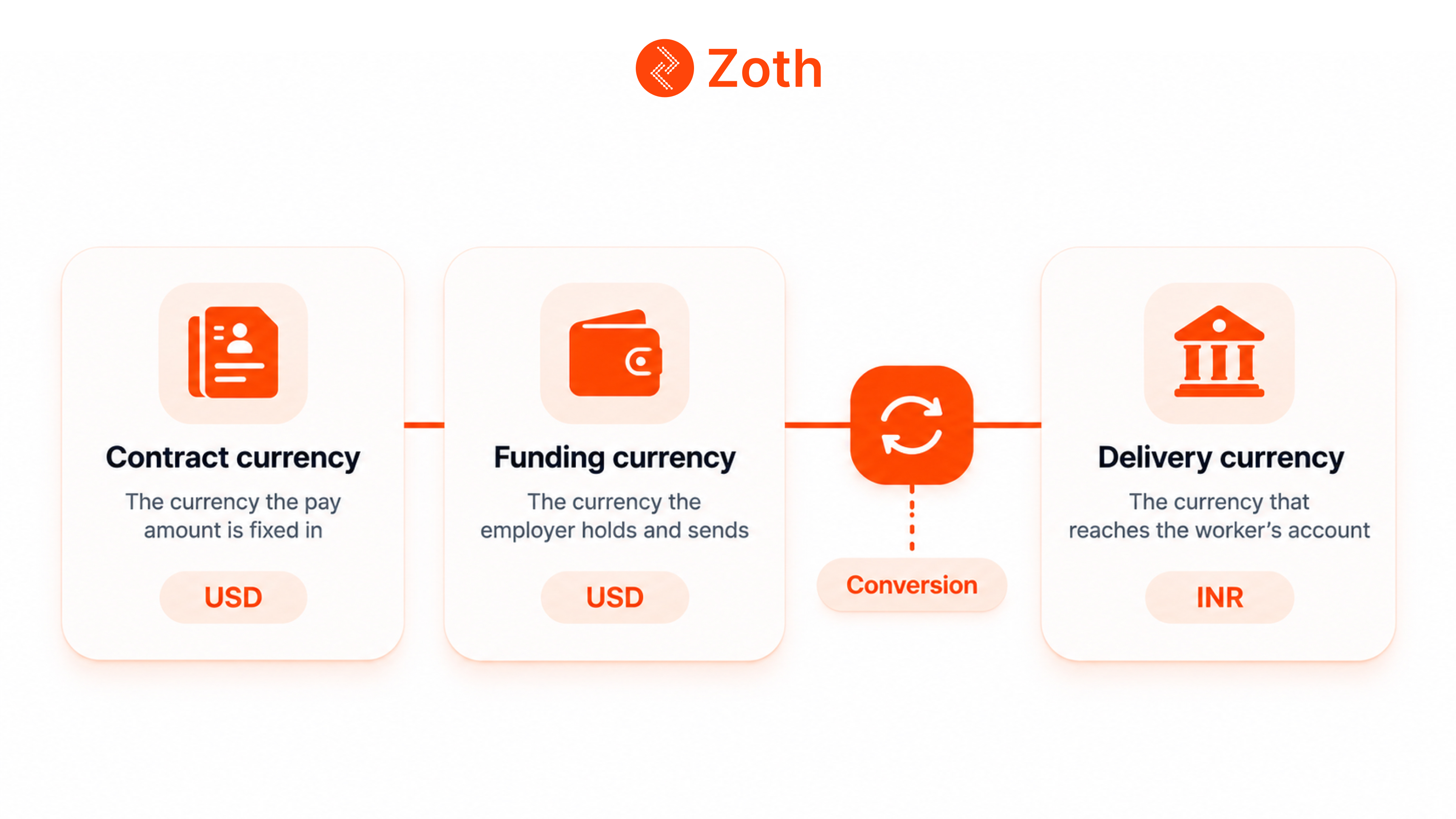
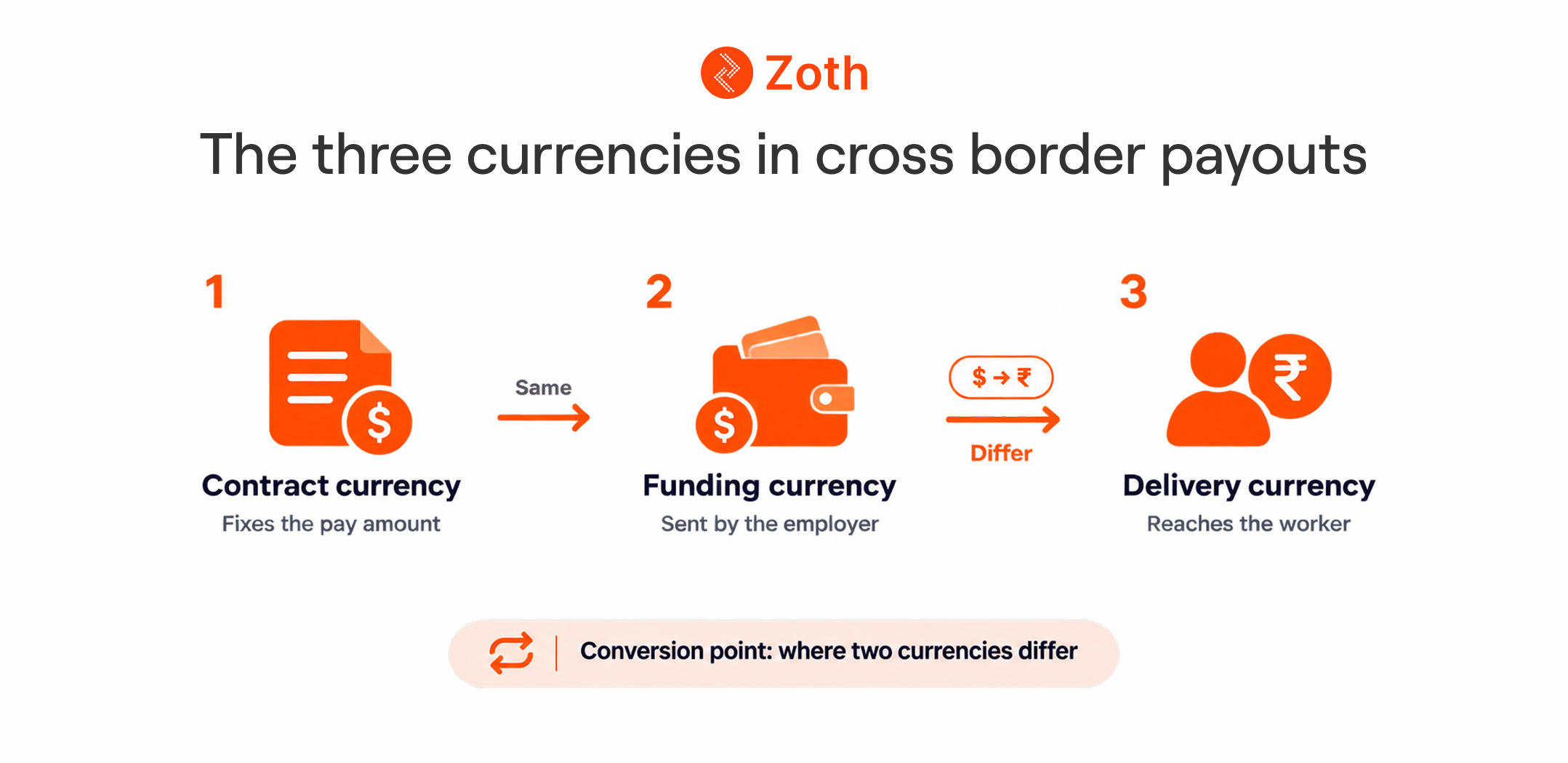
Every pay run involves three currencies, and they need not match.
- Contract currency. The currency the pay amount is fixed in. This is the pay currency.
- Funding currency. The currency the employer holds and sends.
- Delivery currency. The currency that reaches the worker's account.
A conversion happens wherever two of the three differ, and each conversion carries an FX spread. The US dollar was on one side of 89% of trades in the FX market in April 2025, which made it the most traded currency. The pay currency does not remove the conversion. It decides who absorbs the result.
Who carries the FX risk in cross-border payroll payments?
FX risk is the chance that the exchange rate moves between the day pay is agreed and the day it is paid. Three structures allocate it differently.
Pay set in USD
The employer's cost is fixed and the worker's income is not. The Federal Reserve's annual averages put the rupee at 83.66 per dollar in 2024 and 87.15 in 2025. A $4,000 monthly contract converted to about ₹334,600 at the 2024 average and about ₹348,600 at the 2025 average. The yen moved the other way, from 151.46 to 149.57, so the same contract paid fewer yen. The worker's income changed. The contract did not.
Pay set in local currency
This is local currency payroll. The worker's income is fixed and the employer's dollar cost moves with the rate. IAS 21 covers transactions in a currency other than the employer's functional currency for companies reporting under IFRS. The exposure becomes a treasury item to budget for.
Pay pegged to USD, delivered in local currency
The contract fixes a dollar amount and the worker receives its local currency value at the rate on pay day. The risk stays with the worker, but the conversion happens once, at a rate a provider can state before the run.
| Structure | Employer's cost | Worker's income | Carries the rate move |
| Set and delivered in USD | Fixed | Varies; worker's bank converts | Worker |
| Pegged to USD, delivered in local currency | Fixed | Varies; one stated rate | Worker |
| Local currency payroll | Varies | Fixed | Employer |
Where wage law limits the currency for cross-border payroll payments
For employees receiving cross-border payroll payments, the choice is not always open. The ILO's wage standards call for wages to be paid in legal tender. Japan's Labor Standards Act requires wages to be paid in currency, in full and directly to the worker, with stated exceptions. The Philippine Labor Code bars wage payment in anything other than legal tender, with limited exceptions.
Contractor agreements usually leave the currency to the two parties. How each rule applies to a given worker is a question for local counsel.
How should a CFO choose the pay currency for cross-border payroll payments?
Four questions settle most cases.
- Is the worker an employee or a contractor? Wage law may already set the answer for employees.
- Where are the worker's costs? Rent and school fees in pesos point to local currency payroll.
- Who can absorb the rate move? A treasury team can budget for it. An individual on a monthly income usually cannot.
- How is the rate set? A contract can fix a rate for its term, float at the rate on pay day, or float inside an agreed band.
The answer belongs in the contract, with the reference rate named.
The ROI of the pay currency in cross-border payroll payments
The return sits on three lines, measured per corridor for a monthly pay run.
| Line | What the CFO measures | What zPayments provides |
| FX loss per pay run | Gap between the mid-market rate and the applied rate × run amount | One stated rate, shown with each landed amount before the run |
| Top-ups | Value of payments sent again because pay landed short | Each payee's local currency amount, visible before approval |
| Query hours | Hours spent on rate and shortfall queries × loaded hourly cost | Every payout tracked, with exportable records |
Annual cost of a route = (FX loss per pay run + top-ups + query hours) × 12, plus provider fees. The return is the gap between two routes.
As an illustration, a $120,000 monthly run converted 1.5% away from the mid-market rate absorbs $1,800 per run, or $21,600 a year. These figures are illustrative, not a zPayments quote.
Local currency payroll payouts with zPayments
Zoth Payments Limited is registered with FINTRAC as a money services business (C10001622) and operates zPayments. A business funds each pay run from its own wallet, and Zoth Payments Limited holds no client balance. Value moves on stablecoin rails and lands in local currency through regulated payout partners in each corridor. Every customer and payout is subject to KYC/KYB verification, sanctions screening, and on-chain monitoring, with required originator and beneficiary information accompanying qualifying transfers under applicable Travel Rule requirements. zPayments handles the payout, not payroll calculation, tax, or employment filings.
Running cross-border payroll payments into emerging markets? Audit your cross-border payout fees with an international payment specialist at zPayments.
Frequently asked questions
What are cross-border payroll payments?
Cross-border payroll payments are salaries or contractor fees sent by an employer in one country to workers in another. A conversion applies whenever the funding currency differs from the currency the worker receives.
How can a business pay an overseas development team in local currency without losing money on FX?
Some conversion cost is unavoidable when dollars become rupees or pesos. The loss is easier to control when the conversion happens once, at a rate stated before the run, and the payment lands through a local rail. Comparing the applied rate with the mid-market rate on each run shows what was absorbed. zPayments states one rate before the run.
Is it better to make cross-border payroll payments in USD or in local currency?
Neither suits every case. USD fixes the employer's cost and leaves the rate move with the worker. Local currency payroll fixes the worker's income and moves the exposure to the employer.