
How to Reduce Cross-Border Payment Costs by 50% on Small Payouts
Key highlights
- A flat fee takes a larger share of a smaller amount, so small payouts cost the most per dollar.
- Sending $200 costs 5.7% on average and sending $500 costs 3.8%, the Financial Stability Board reported in 2026.
- International payment fees are either flat charges per payment or percentage charges on the amount sent.
- To reduce cross-border payment costs, finance teams should start with flat charges repeated on every payout.
- A payout threshold and a three-line ROI framework show a CFO how to reduce cross-border payment costs.
- Cutting an 11% effective cost on a $300 payout down to 5.5% a 50% reduction starts by eliminating flat fees repeated on every transfer.
A platform paying 2,000 contractors $300 each moves $600,000. So does a company paying 20 suppliers $30,000 each. At a $30 flat fee per payment, the first pays $60,000 in fees and the second pays $600. Flat fees follow the number of payments. When a $300 payout carries an 11% effective cost, cutting that cost in half to 5.5% saves $396,000 a year on 2,000 monthly payouts and any plan to reduce cross-border payment costs starts there.
Three terms frame the problem:
- Small payouts, in this guide, are cross-border business payments of under $500 to contractors, sellers or other payees.
- A flat fee is a charge that stays the same regardless the amount sent.
- Effective cost is every charge on a payout, added up as a percentage of the amount sent.
To reduce cross-border payment costs on small payouts is to lower that percentage, not the fee on a price list. Earlier guides cover the FX spread and intermediary bank fees. This one covers the small payout.
Why is it harder to reduce cross-border payment costs on small payouts?
A fixed cost takes a larger share of a smaller payment, so the cost in percentage terms rises as the payout shrinks. Remittance pricing is the closest public measure for small payouts. The World Bank tracks the cost of sending $200 and $500. The Financial Stability Board (FSB), in its 2026 progress report of 16 November 2026, puts the global averages at 5.7% and 3.8%.
A Reserve Bank of India (RBI) remittances survey found a weighted average cost of 4.6% on transfers into India below $200 in 2023-24, against 2.4% for $200 to $500. The RBI's reason: fixed costs form a smaller share as the amount rises.
Small payments look cheap in dollars, and efforts to reduce cross-border payment costs stall there.
Where do international payment fees sit in a small payout?
International payment fees come as fixed charges, as percentage charges and as deductions at the receiving end.
Charges that stay fixed
Wire fees, per-transfer platform fees and bank deductions along the route apply per payment, regardless of the amount.
Charges that scale with the amount
An exchange rate margin is a percentage, so at 1% it takes 1% of any payout.
Deductions at the receiving end
The recipient's bank or wallet can also charge. The FSB's 2026 report puts receiver-side costs at 1.4% of value on payments below $500, plus 0.9% where a currency conversion applies. Its 2025 report found that the fee part falls as payment value rises, while the FX margin stays stable.
The table applies an illustrative $30 flat fee and 1% exchange rate margin to four payout sizes.
| Payout | $30 flat fee | 1% FX margin | Effective cost |
| $100 | 30% | 1% | 31% |
| $300 | 10% | 1% | 11% |
| $3,000 | 1% | 1% | 2% |
| $30,000 | 0.1% | 1% | 1.1% |
The same international payment fees cost ten times as much per dollar on a $300 payout as on a $30,000 one.
How the 50% reduction works in practice: On a $300 payout, a $30 flat fee and a 1% FX margin add up to an 11% effective cost ($33). Cutting that effective cost in half down to 5.5% ($16.50) means cutting total payment costs by 50%. A company can reach that drop by removing flat per-transfer charges or raising the payout threshold so a single fixed fee covers a larger balance.
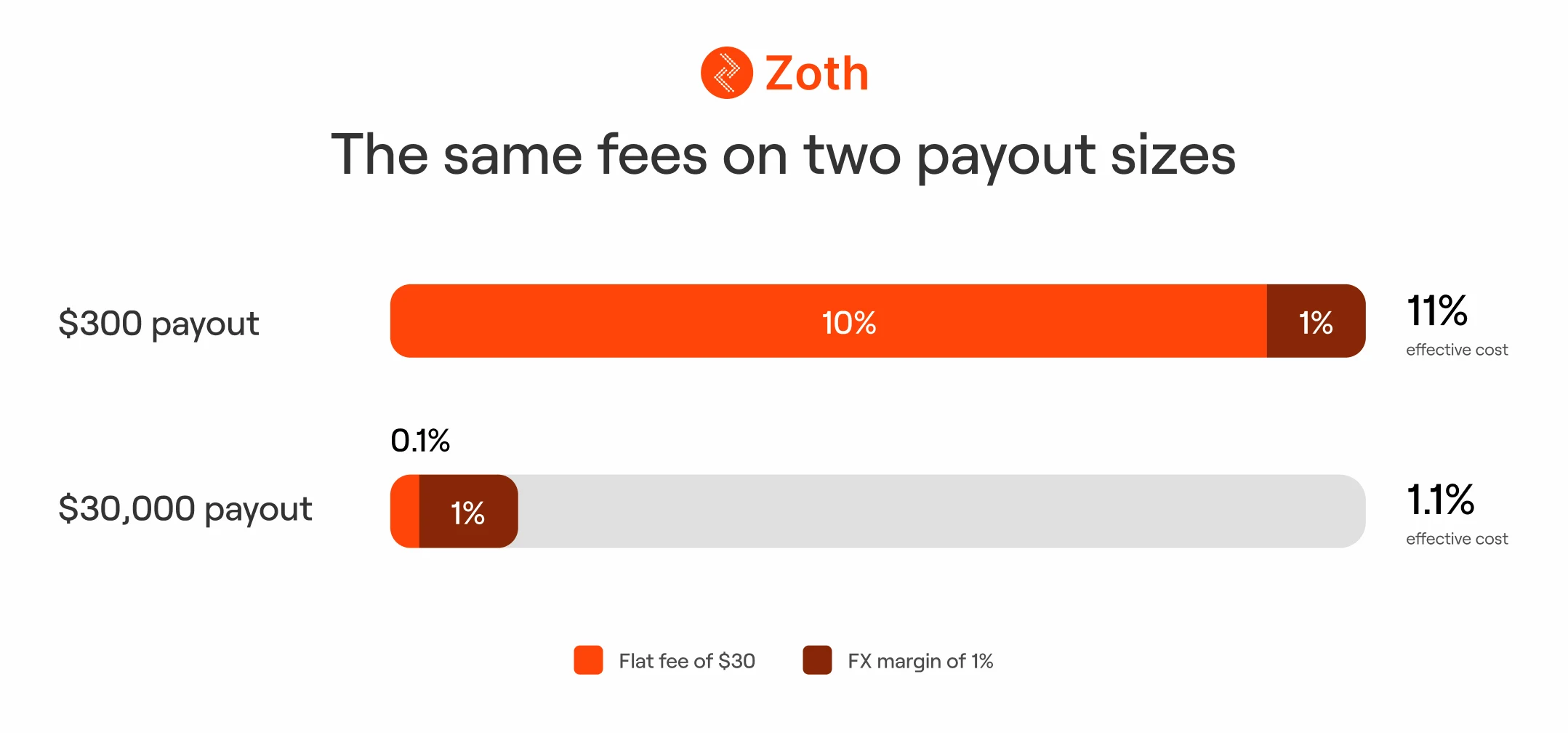
The chart compares the baseline effective cost on a $300 payout (11%) and a $30,000 payout (1.1%) before cost-reduction moves.
How to reduce cross-border payment costs on small payouts
Four moves follow from the arithmetic.
- Measure effective cost by payout band. Group last quarter's payouts into under $200, $200 to $500 and above $500. Divide the charges in each band by the amount sent.
- Remove flat charges that repeat. Ask each provider which international payment fees are per payment and which are percentages. Each flat fee removed saves its value on every payout.
- Quote the route at the real payout size. Request the recipient amount for a $300 payout, not a $30,000 one. Rates and minimum charges can differ by amount.
- Set a payout threshold. Where contracts allow, hold small balances until they reach a set amount.
How does a payout threshold reduce cross-border payment costs?
A payout threshold is the minimum balance a business builds up before it pays a payee, so one flat fee covers a larger amount.
Threshold = flat fee ÷ target cost share
The G20 target for retail cross-border payments is a global average cost of no more than 1% by end-2027. Holding a flat fee to 1% takes a threshold of $3,000 at a $30 fee and $200 at a $2 fee.
A threshold has its own cost: the payee waits longer. It can reduce cross-border payment costs only where the business sets the payment schedule, since contracts and wage rules can fix the date.
An ROI framework to reduce cross-border payment costs
The return sits on three lines, measured over one year of small payouts.
| Line | What the CFO measures | What zPayments provides |
| Flat charges | Flat charges per payout × small payouts a year | No platform or usage fee; local network commission itemised before approval |
| FX cost | Gap between the mid-market and applied rate × annual small-payout volume | One stated rate with the FX fee inside it, quoted before approval |
| Top-ups | Value of payments sent again because a payout landed short | The final landed amount, shown before approval |
Annual cost of a route = flat charges + FX cost + top-ups. The return is the gap between two routes.
As an illustration, 2,000 payouts a month make 24,000 payouts a year, so each $1 of flat charge per payout costs $24,000 a year. These figures are illustrative, not a zPayments quote.
Where zPayments fits in a plan to reduce cross-border payment costs
Zoth Payments Limited is registered with FINTRAC as a money services business (C10001622) and operates zPayments. A business funds each payout from its own wallet, and Zoth Payments Limited holds no client balance. Value moves on stablecoin rails and lands in local currency through regulated payout partners in each corridor. Every customer and transaction undergoes KYC/KYB verification, sanctions screening, and on-chain monitoring, with required originator and beneficiary details accompanying qualifying transfers under applicable Travel Rule rules.
zPayments charges no platform or usage fee. A payout costs the FX fee, which sits inside one stated rate, plus the local network commission. The quote shows both, with the landed amount, before approval.
Looking to reduce cross-border payment costs on small payouts into emerging markets? Audit your cross-border payout fees with an international payment specialist at zPayments today.
Frequently asked questions
Why do small international payments cost more in percentage terms?
A flat fee does not shrink with the payment. The Financial Stability Board's 2026 report puts sending $200 at 5.7% on average and $500 at 3.8%.
How can a business reduce cross-border payment costs on small payouts?
Start with charges fixed per payment, which take the largest share of a small amount. Then measure cost by payout band, quote routes at the real payout size and set a payout threshold.
Do international payment fees change with the size of the payment?
Flat fees stay the same in dollars, so their share rises as the payment falls. Percentage charges take the same share at any size.
How does a CFO measure the return on efforts to reduce cross-border payment costs?
Add flat charges, FX cost and top-ups for one year on each route. The return is the gap between the two totals.